We lied to ourselves again, Russians write, as Ukrainians reportedly advance beyond the Zherebets river (Ukraine Battlefield update, Day 1,665)
Ukrainians brace for another winter of blackouts, but are still overwhelmingly continuing resistance.

The Russian front near Lyman is retreating, bringing significant relief to Sloviansk.
- Ukraine was initially meant to fall within three days; now Putin adviser Patrushev is making the same threat to Poland.
- 77 percent of Ukrainians want to continue resisting through the winter even without electricity and heating, with Kyiv residents the most determined.
- Another Russian general has been killed — his unit is fighting near Kostiantynivka.
- Map of the day — Lyman according to the Russians.
- Videos of the day — an election campaign advert on Russian television; Ukrainian depots burn just like Russian ones; a Ukrainian grandmother takes apart a Russian drone; an interceptor drone armed with a shotgun shoots down an enemy craft over a frontline city.
The Russian front near Lyman is retreating, bringing significant relief to Sloviansk. The situation near Orikhiv is gradually deteriorating, while Russians are continuing to push near Dobropillia, Kostiantynivka, Sloviansk and Kramatorsk, as well as in the north of Kharkiv region. Russian Z-channels are reporting on each of these locations in a way that leaves no room for doubt about the Russian army’s successes.
But alongside celebratory and objectively nonsensical claims — most recently, for example, several Russian sources claimed that Orikhiv had been captured — Russians are also debating their defeat near Lyman. The same accounts that eagerly exaggerate and publish false information are once again complaining that things went badly near Lyman because someone in the army lied to both them and Russian president Vladimir Putin.
This comes two weeks after Putin, relying on military reports, announced the capture of the town of Sviatohirsk. Today, Russians report that the front is already 27 km further east and that Ukrainian soldiers are advancing even further across the Zherebets river.
“Alongside strikes on the Ukrainian rear and the Russian army’s successes near Orikhiv and Dobropillia, the consequences of excessively embellished reports continue to emerge in the Lyman direction,” the major Telegram channel Rybar wrote.
Just two weeks ago, Rybar itself was drawing entirely nonsensical maps. It is now publishing relatively detailed information that completely changes the picture of the battle for the northern flank of the Sloviansk-Kramatorsk urban area.
“The enemy’s 3rd Army Corps and units subordinate to it have moved into active operations and achieved tactical successes that call into question a further assault on the city itself,” Rybar wrote about Russia’s prospects of capturing Lyman, the gateway to Sloviansk from the north-east.
Rybar’s map now looks entirely different. There is no longer any trace of the salient north of Lyman, and it is covered with blue arrows showing the directions of Ukrainian attacks.
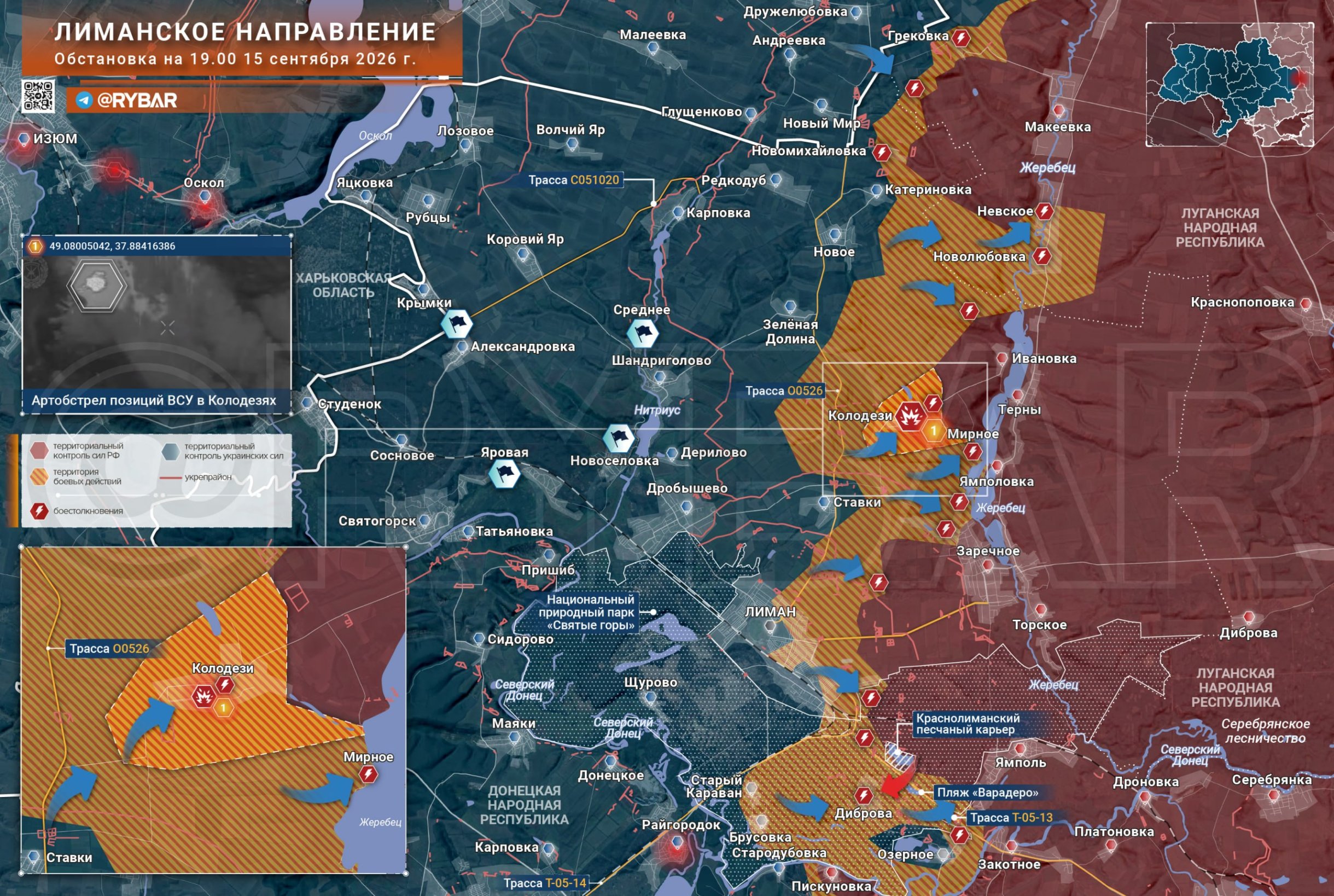
Ukrainian units are in Novoselivka, Yarova, Oleksandrivka and Seredne, Rybar acknowledged, but it merely repeated the names of villages confirmed in a video by Ukraine’s 3rd Army Corps on Tuesday (15 September).
According to independent analysts, some footage in the compilation is several months old and the situation is considerably more favourable to Ukraine than the Russians themselves admit.
As we have already written, this is the result of an operation named Vivaldi because it has four phases, and this is the first. “To be continued!” were the words concluding the 3rd Corps’ post.
Українські прапори над очищеною від окупантів землею!
— Третій армійський корпус (@ab3army) September 15, 2026
Бійці Третього армійського корпусу та приданих підрозділів повернули синьо-жовті стяги у населених пунктах Середнє, Новоселівка, Ярова та на околицях Корового Яру.
Операція «Вівальді». Сезон перший. Далі буде! pic.twitter.com/o6k55y7UkD
The next step may be an attempt to cross the Zherebets river. Rybar claimed that this was already happening: “According to some reports, Ukrainian sabotage groups that crossed the Zherebets river in the area of the Zhuravka ravine are operating east of the river and are attempting to enter the villages of Terny and Yampolivka. Supplies for the Russian bridgehead west of Lyman passed through them, and enemy activity at this location points to a difficult situation on both banks of the river.”
Rybar claimed that this was not a strategic defeat, but that the setback would delay the assault on Sloviansk. This was partly because units attacking it from the east no longer have their flank protected against counter-attacks from the north.
Another Russian, Oleg Tsarev, wondered why the entire operation was being conducted in complete silence on the Ukrainian side, given that, in his view, Kyiv needed to highlight a success in order to show its allies that it could continue fighting.
“It must be said that this is an effective tactic. If they were loudly announcing [their successes], the leadership of the Russian Federation would hear them. But now, it seems, the information is not reaching the top. War correspondents, with rare exceptions, are silent: nobody wants trouble. Ukraine is silent too,” Tsarev invoked the old Russian trope of a good ruler whose incompetent boyars lie to him and thereby ruin his plans. He omitted the fact that people like him are part of the problem.
So did Yuri Kotenok, who otherwise draws entirely fabricated maps. It was he who now announced the capture of Orikhiv and speculated about the suspicious Ukrainian silence. He even warned against a repeat of the story of the allegedly captured Kupiansk and other similar places — although he himself had loudly celebrated it.
The final sentence of Kotenok’s post is true in that the 3rd Army Corps is indeed a very high-quality formation and includes elite units. The rest, however, mainly serves as an example of the Russian way of reporting on the war:
“The enemy attacking near Lyman with mechanised groups is battle-hardened and experienced. They are not frightened conscripts — drug addicts or disoriented scum — but fully motivated Nazis from Azov… Has there not been enough playing around with murderers? And yes, open your eyes, those of you who still keep them shut; open your ears, those of you with plugs in them: fighting and retreating is not shameful; what is shameful is concealing things and lying, including to the Supreme Commander.”
Paradoxically, the DeepStateUA map of this area fully corresponds with what the Russians are writing — the Ukrainians are completely silent.

Ukraine was initially meant to fall within three days; now Putin adviser Patrushev is making the same threat to Poland. “If Russia attacked us and if we did not throw in the towel, I think we would defeat Russia quite quickly. We have overwhelming air superiority over Russia… If Ukrainians were able to take out half of Russia’s refining capacity in six months, we would be able to take out the other half in six weeks,” Polish foreign minister Radek Sikorski said at a conference in Kyiv.
He did not mean Poland alone, but Nato as a whole, including in the event that the United States betrayed its allies and did not help them.
At this point, it is not important whether this is a realistic scenario. At a time of escalating Russian provocations, Poland — and Sikorski personally — are communicating with the Kremlin in a way intended to make clear that they are not afraid of it and will not yield to Putin.
The Polish minister’s statement quite naturally provoked a strong reaction. After returning home, he published a short post repeating the same point: “… thanks to air superiority, the air forces of Nato’s European component, even without US involvement, would be able to destroy half of Russia’s refineries faster than Ukraine. I still think so.”
Żeby było jasne co powiedziałem w Kijowie. Że w wypadku rosyjskiej agresji na NATO, dzięki przewadze w powietrzu, lotnictwo europejskiej części NATO byłoby w stanie, nawet bez udziału USA, zniszczyć połowę rosyjskich rafinerii szybciej niż Ukraina.
— Radosław Sikorski 🇵🇱🇪🇺 (@sikorskiradek) September 14, 2026
Nadal tak uważam.
As Sikorski is Polish, his remarks quite naturally received the most attention in Poland. This included criticism, of course. But military analyst Jaroslaw Wolski strongly praised the minister. He believes that this is precisely the language in which Russia should be addressed:
“Sikorski told the truth — hence the outcry from Russia’s fifth column after his remarks. And the laughter of fools who do not understand that perhaps Poland alone would not, but Poland, Finland, Denmark, Norway and Sweden together have greater air power than Russia. Adding France, Germany, the United Kingdom or Italy makes the balance hopeless for Russia.
And this must be made clear.”
According to Wolski, Russia is an “air dwarf”. He referred to a consensus among analysts that Nato’s European component alone would gain complete air superiority within a month and would be able to strike targets deep inside Russian territory.
“Threatening people with Gerans, Kh-101s and Iskanders makes sense only if you can produce them in large numbers, and Russia would very soon be unable to do that. The factories would be destroyed, forcing production to be dispersed and reducing its volume,” the Polish analyst added.
Determining the real strength of air forces is not so straightforward. Official statistics state that Russia’s military air force has a total of 4,237 aircraft, while Nato armies have 20,375. But this includes everything from the most modern combat aircraft to non-combat support types.
Comparing combat aircraft alone, Nato has an approximately 4.5-fold advantage with the US included, and not quite a twofold advantage without the United States. It is still sufficient, exactly as Sikorski and Wolski argue.
Moreover, there is a significant difference between official statistics and the real situation. The Russian air force is suffering losses and its aircraft are being technically worn down by intensive combat deployment, meaning that the number of genuinely combat-ready aircraft is considerably lower than statistical yearbooks suggest. This also applies to Western air forces, though to a lesser degree. For a simple reason: their aircraft are not fighting.
Another point in Nato’s favour, including its European component, is its technological superiority. Finland, Denmark, the Netherlands, Belgium, Norway and now Poland are either extensively re-equipping, or have already re-equipped, with fifth-generation F-35 aircraft.
Russia lags significantly behind in both numbers and quality. It classifies the Su-37 as a fifth-generation aircraft, but it does not, for example, achieve the same level of stealth as the F-35.
Back to Sikorski. The crucial part of his statement comes at the very beginning, which starts with the words: “If Russia attacked us…”. The Polish foreign minister therefore clearly framed his claim as self-defence against a Russian attack. Under no circumstances did he even suggest that Nato would launch an unprovoked attack on Russia.
That did not prevent Russia from offering an entirely different narrative at home. This week, Putin adviser Nikolai Patrushev, who is speculated to be a possible successor to Putin, implicitly but unmistakably threatened Poland with nuclear weapons: “If Poland uses military force against Russia, our country will use its entire arsenal of forces and resources, and Polish statehood will cease to exist within two or three days.”
To underline what exactly he meant by the entire arsenal, Patrushev added that Sikorski assessed Russia’s military strength amateurishly and “refuses to understand that, during the special military operation, the Russian armed forces are by no means using their full potential”.
Russia has thus returned to rhetoric that failed it in Ukraine and remains the subject of ridicule to this day.
To illustrate the extent to which this is a militarised society fixated on war, it is worth looking at the official pre-election advert for Duma elections. It is broadcast on state television, was created using AI and, instead of a political programme, essentially tells Russians through historical figures from the Middle Ages to the second world war only that they are in a war that will continue, and that they should be prepared to die for the state.
Russian state TV is using AI slop featuring historical warring figures such as Alexander Nevsky, Kutuzov and Zhukov as well as those currently fighting in Ukraine to promote this weekend’s parliamentary election pic.twitter.com/Hs8HaItN2D
— Francis Scarr (@francis_scarr) September 15, 2026
77 percent of Ukrainians want to continue resisting. This follows from a new survey by the Kyiv International Institute of Sociology, a respected Ukrainian public-opinion polling agency.
The pollsters asked respondents whether Ukraine should continue resisting even if Russia attacks energy infrastructure during the winter, resulting in electricity, heating and sewage outages.
77 percent of respondents supported continuing the fight, 12 percent supported accepting Russia’s terms, and 11 percent were undecided.

Surprisingly, Kyiv residents — who suffered most during the previous winter and are certain to face the same now — gave the highest share of positive responses, at 83 percent. Respondents from eastern Ukraine showed the least willingness to continue resisting, but even there more than two-thirds supported it: 68 percent.

Even more interesting are the responses broken down by whether respondents trust president Volodymyr Zelensky. Of those who do, as many as 89 percent support continuing the fight. But 65 percent of those who do not trust Zelensky also responded positively. This group clearly had the highest share of those who would surrender to Russia: 20 percent.

Another Russian general has been killed — his unit is fighting near Kostiantynivka. Russian sources first reported this shortly before midnight on Tuesday. Among them was the Z-channel run by Yuri Kotenok, which published a photograph of the dead man and basic information about him.
The officer was Major General Anton Grunis, who commanded the 4th Guards Motor Rifle Brigade. As recently as 28 August, Putin awarded him the Gold Star of Hero of Russia for the “liberation” of Kostiantynivka. The minor problem is that Ukrainian soldiers are still present in Kostiantynivka.
The so-called Suvorov Brotherhood, a group of graduates of the Suvorov officer school in Kazan, was the first to confirm the report.
Grunis fought in Chechnya, Georgia and Syria — that is, everywhere Russia pursued its imperial policy. He entered the reserves in 2021 but returned to the army after the invasion began.
Grunis took command of the 4th Brigade in May 2023, when it was fighting for Klishchiivka near Bakhmut. He replaced its previous commander, who had been killed together with his staff in a Ukrainian army missile strike.
The brigade later fought for Chasiv Yar and is currently deployed near Kostiantynivka.
On Wednesday morning, Magyar’s Birds — the nickname of an elite Ukrainian army drone unit — also confirmed the report that the general had been killed. According to its post, Grunis was the seventh commander at brigade, division or army level killed by Magyar’s Birds.
Their commander, Robert Brovdi, announced that Grunis “was eliminated on 12 September 2026 in his night shelter in temporarily occupied territory of Donetsk region”.
Magyar update on General Grunis:
— 414 Magyar's Birds (@414magyarbirds) September 16, 2026
“A man with a Lithuanian surname, born in Kazan, is fighting brilliantly” – putin on General Grunis (“Grozny”), who reported in July on the complete capture of Kostiantynivka and subsequently received the Hero of russia title.
As a man with a… pic.twitter.com/R95bgOACAO
Videos of the day
A Ukrainian drone shot down a Russian one using a shotgun. The duel took place above a destroyed city directly on the front line.
🤯 WOW: Unique footage shows Ukrainian drone use shotgun to down Russian UAV. pic.twitter.com/EsCQfmNRu9
— UNITED24 Media (@United24media) September 14, 2026
If you ever happen to find a drone with an unexploded charge, be more careful than this Ukrainian grandmother. She was probably only touching a spool of fibre-optic cable, but it is far from certain that she knew it was not an explosive charge.
Бессмертная бабка (не надо так)https://t.co/PokZlzocI8 #дроноцид pic.twitter.com/MrSPNYd2SI
— Necro Mancer (@666_mancer) September 15, 2026
Ukrainian depots burn just like Russian ones. Kyiv after a Russian air raid; date unknown.
❗️Almost all buildings completely destroyed: footage of the aftermath of Russian strikes on warehouses in the Kyiv region
— MAKS 26 🇺🇦👀 (@Maks_NAFO_FELLA) September 15, 2026
The date of the video is unknown. pic.twitter.com/vTU7uBIXqf
What are the losses
No update on Wednesday.
By Monday (14 September), Russia had verifiably lost 24,098 pieces of heavy equipment, compared with 24,066 on Monday (7 September). Of these, Ukrainians destroyed 19,065 (19,034), 1,000 (1,000) were damaged, crews abandoned 1,194 (1,194), and the Ukrainian army captured 2,839 (2,838). This includes 4,447 (4,446) tanks, of which 3,352 (3,351) were destroyed in combat.
- Ukraine lost 12,143 (12,097) pieces of equipment, of which 9,551 (9,507) were destroyed, 698 (698) damaged, 695 (693) abandoned and 1,199 (1,199) captured. This includes 1,462 (1,462) tanks, of which 1,120 (1,120) were destroyed in combat.
Note: Neither side regularly reports its own fatalities or destroyed equipment. Ukraine publishes daily figures on Russian casualties and destroyed equipment, but these cannot be independently verified. This overview uses data from the Oryx project, which has compiled a list of equipment losses documented exclusively by photographs since the beginning of the war.


